DemocracyHQ
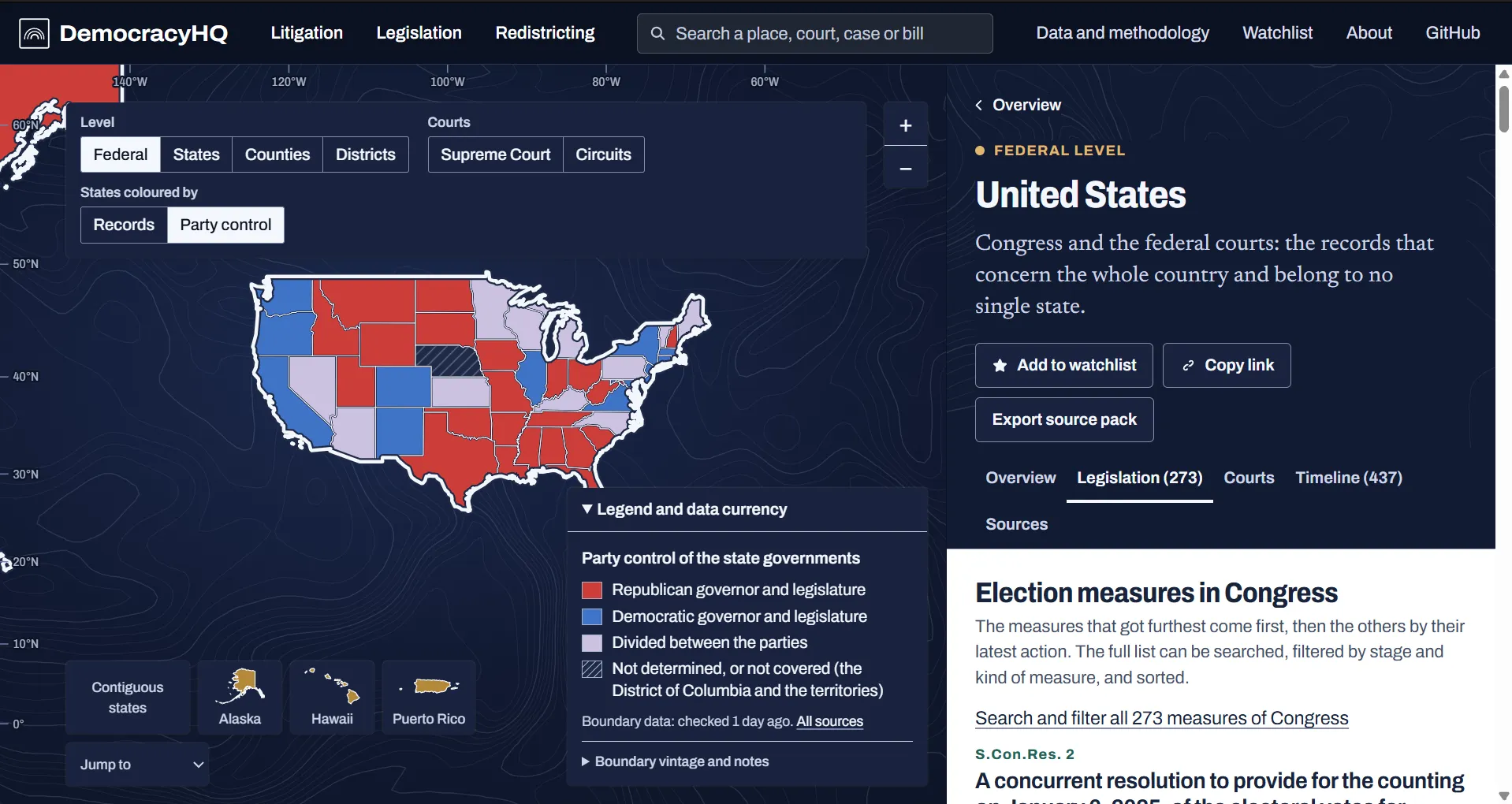
An open research tool that puts election litigation, election legislation and electoral boundaries in the United States on one map, every record linked to its source.
- Problem
- The public record of election law is spread across court dockets, legislative databases and Census files. Each is hard to search on its own, and almost impossible to read together.
- Built
- A Python pipeline that retrieves records from official sources and classifies them by published rules, and a static map-based site that reads the resulting JSON. Every entry says where it came from and when it was last checked.
Why
Questions about election law are questions about records: what a court docket says, which version of a bill passed, which boundaries a case is about. Those records are public, but they live in different systems that do not refer to each other. DemocracyHQ does not summarise or interpret them. It collects them, connects them, and shows where each one came from.
How it works
DemocracyHQ is two programs that meet at a folder of JSON files.
- Pipeline. Python adapters fetch and parse records from official sources, including Supreme Court dockets, GovInfo, CourtListener and its RECAP Archive, state legislative data and Census boundary files. Records are selected and tagged by keyword rules that are themselves published with the data, links are checked against quoted evidence, and the release is validated before it is written.
- Release manifest. Each data release carries a manifest with record counts, per-source status, the size of the review queue and a SHA-256 hash over every published file.
- Static site. React, TypeScript and MapLibre GL JS read the JSON directly. There is no server, database, account system, cookie or analytics, and the content security policy only allows requests to the site’s own address.
- Scheduled updates. GitHub Actions runs the pipeline, commits changed data and redeploys the site.
Status
An early, working prototype, published in November 2026. Coverage is uneven by design while the method is being proven, and the site says so on every page: a gap in the data is not evidence that something does not exist. It is a research and educational tool, not legal advice.