Work

Software I have designed and built, alone or in a team, from a released browser extension to early prototypes.

How far along

  • ReleasedPublished and used by people outside the team.
  • Live prototypePublicly reachable, but incomplete and changing.
  • PrototypeWorks on real or demonstration data. Not deployed for real use.
  • ExperimentalResearch software. Its outputs test the code, not a claim.
  • Early developmentBeing built. No public code or results yet.
  • Ongoing researchAn open question under study. No results yet.

Projects

DemocracyHQ

Live prototype2026

An open research tool that puts election litigation, election legislation and electoral boundaries in the United States on one map, every record linked to its source.

Problem
The public record of election law is spread across court dockets, legislative databases and Census files. Each is hard to search on its own, and almost impossible to read together.
Built
A Python pipeline that retrieves records from official sources and classifies them by published rules, and a static map-based site that reads the resulting JSON. Every entry says where it came from and when it was last checked.
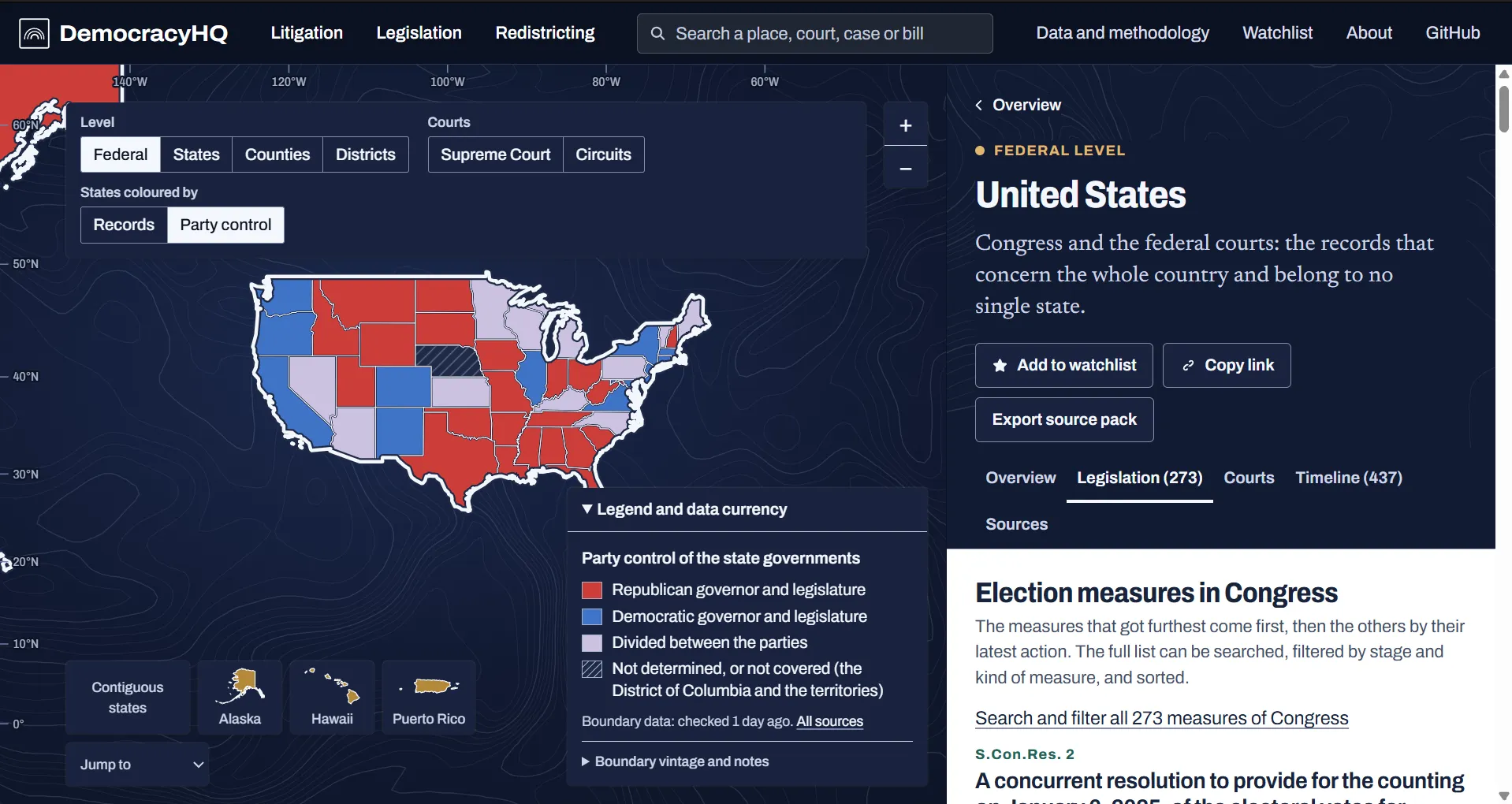
The DemocracyHQ interface. A map of the United States with states coloured by party control of state government, and a panel for the federal level listing election measures in Congress.
The federal view, with party control of state governments on the map and election measures of Congress in the panel.

Enterprise AI for advertising sales

PrototypeProof of conceptNov 2025 – Jan 2026

A prototype that turns scattered advertising product documentation into a structured, queryable database with a sales assistant on top.

Problem
Specifications for roughly 800 advertising products across more than 30 brands lived in inconsistently formatted PDFs and web pages. Nobody could list the whole portfolio, so sales conversations depended on a few specialists.
Built
A pipeline that discovers and extracts product documents into a validated PostgreSQL schema with source tracking, and an assistant that answers sales questions from that data through a FastAPI interface.

Wikipedia Quick Search

Released2026

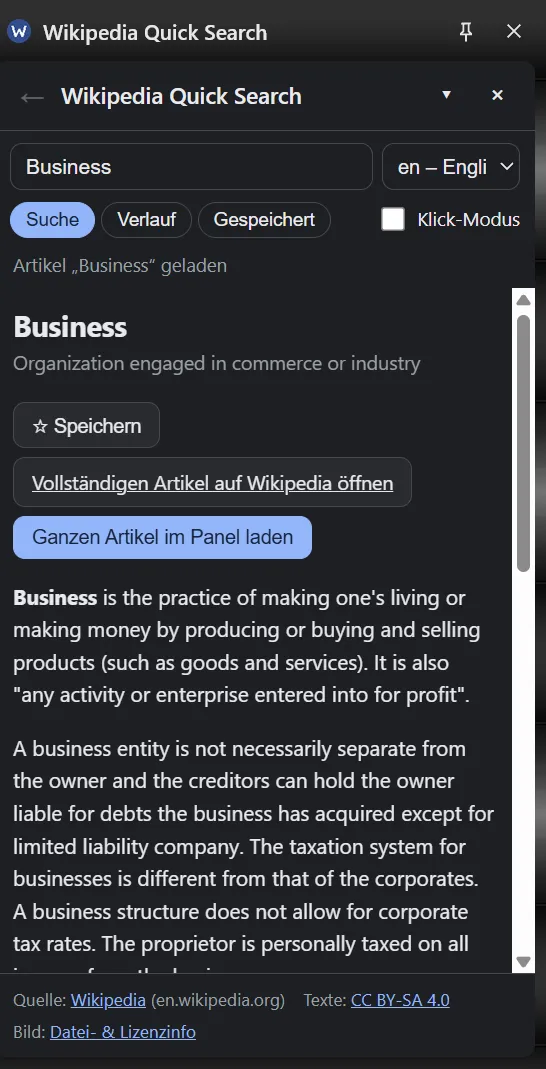
A browser extension that opens the Wikipedia article for any selected text in the browser’s side panel.

The Wikipedia Quick Search side panel showing the article "Business", with search, history and saved-articles tabs, a language selector, and a licence notice for the Wikipedia text at the bottom.
The side panel in Chrome. The interface follows the browser language; here it is German.
Problem
Looking something up while reading usually means leaving the page, opening a new tab and losing your place.
Built
A cross-browser extension that answers a keyboard shortcut (Alt+W, or Option+W on macOS) with the matching article in a native side panel, straight from Wikipedia’s own API.
Adoption
184 cumulative Chrome installations, as of early November 2026.

HorizonDB

PrototypeHackathon buildSep 2026

A financial research database that keeps track of what it knows, where each figure came from, and what it believed before the latest filing.

Problem
Research databases overwrite history. When a company restates a figure, the old value disappears, and nobody can answer what the data said at a given point in time, or notice on their own that something has gone stale.
Built
An append-only, provenance-first store for a focused set of companies, with a small controller model that reads a compact summary of the database’s own state and decides what to refresh next.

Investment-Bot

ExperimentalResearch software2026

A deterministic research platform for testing trading strategies without letting future information leak into past decisions.

Problem
Backtests are easy to get subtly wrong. A strategy that can see a price before it was published, or a result that cannot be reproduced, says nothing about the strategy.
Built
A single-process Python platform with immutable data snapshots, a clock-bound view of the data, explicit costs and an append-only accounting journal. Version 0.1 tests the mechanics of a seven-ETF monthly momentum strategy.

Supervised security agents

Early developmentSince Nov 2026

An early prototype exploring whether AI agents can help people understand and improve the security of their own computers, under explicit human control.

Problem
Most people cannot tell whether their computer is configured securely. Existing tools either change settings without explaining why or produce reports nobody reads.
Built
A desktop application that runs read-only security assessments on Windows, organises the findings in a security knowledge graph, and proposes guided fixes that only run with explicit permission and leave an audit trail.

The questions I am working on are about reliability and trust rather than capability: what an agent may read, what it may change, how it explains a proposed change before making it, and how every action can be audited afterwards. Assessments are read-only by default, language models run locally, and nothing is modified without the user’s explicit, specific permission.

Amtlotse

PrototypeOct 2026

An unofficial guide through German public administration that answers everyday questions and cites an official source for every statement.

Problem
Dealing with German public administration starts with knowing which procedure applies. The official information exists, but it is written for administrators, not for someone who has just moved house.
Built
A small web app that matches a plain-language question to curated life situations and lets a language model answer only from those excerpts, with a citation for every claim. Without a match, no model is called.

Each life situation is a Markdown file with keywords, a review date and its official sources. Retrieval is deliberately simple (BM25 over at most two matching situations), questions are length-limited and rate-limited, and the app is explicitly not an authority: no federal eagle, no federal colours.